
Big Area
Where were you at 7pm on 18 May 1995?

Last Sunday Music Venue Trust took over the V&A for a day, which is I suspect you will either think is either one of the most or least appropriate things that has ever happened in that building, depending on your view of whether a national institution dedicated to art, design and culture should include in its remit representing the quirky, odd spaces where your ears start ringing at the same time as your feet start dancing. The day featured film premieres, panels, presentations and conversations that felt like this stuff actually matters and deserves to be discussed.
It was the kind of event that gently reminded you why the sector is worth fighting for, even on the weeks when fighting for it feels like trying to bail out the Titanic with a pint glass. Somewhere in the middle of it somebody asked a complex and multi-layered question that I’m still thinking about: If the big shared cultural moment of music is increasingly a thing of the past, is the micro-movement model that has replaced it an adequate substitution, and do any of us who think about these things actually know the answer yet? I am not sure we do.
On 18 May 1995, Pulp performed Common People on Top of the Pops to an audience of just under eleven million people. Not eleven million music fans who had tuned in specially, just eleven million people who happened to have the television on, including people waiting for EastEnders, people who had forgotten to switch over, people who tuned in every week to see what outfit they could be offended by and object to, and most of all people who had never heard of Pulp and after that Thursday evening found they could not get the song out of their heads for the rest of the summer. Common People would finally reach number two in the charts, kept off the top spot by Robson and Jerome, a massive cultural insult which still feels fundamentally like someone was trying to wind us all up. But I digress. What matters here is the mechanism by which that song became an anthem and that artist leapt from alternative interest to mainstream darlings; one band, one song, one programme, one Thursday, eleven million people who did not choose to be there, and a career still generating joy thirty years later.
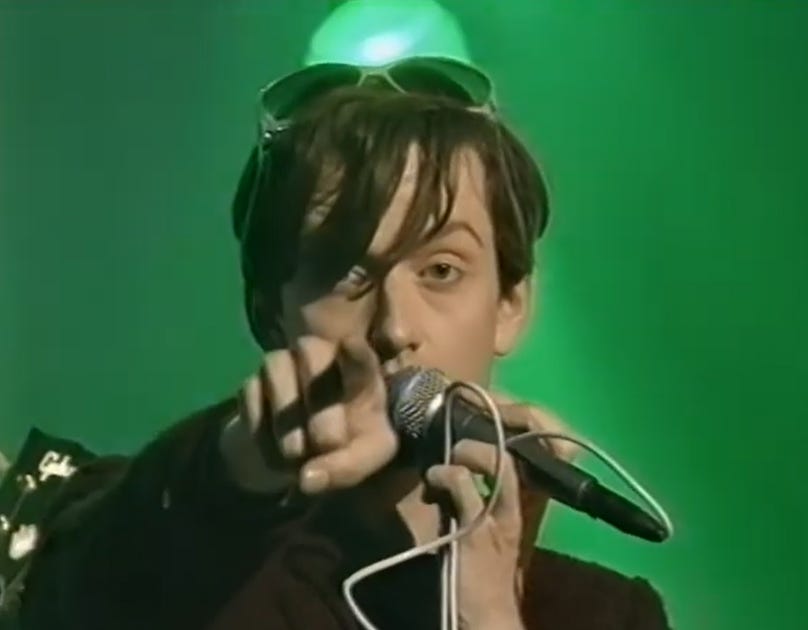
Top of the Pops ended in 2006, announced by the BBC as a “scheduling decision” - technically accurate in the same way that describing the closure of a steelworks as a ‘change to production arrangements’ is technically accurate. By then, The Tube, TFI Friday, and the Old Grey Whistle Test were already gone, having between them covered the decades from the 70s to the 00s, giving television time to acts the mainstream had not yet decided to care about, That function of creating huge music cultural moments out of the unexpected, quirky, edgy and alternative was precisely their value and almost certainly why each show kept getting its budget cut. Later with Jools Holland still runs, on BBC Two, on a Friday, and attracts between 700,000 and 1.2 million viewers depending on the lineup and whether anyone remembers it is on. It occupies a radically different space, watched primarily by people who already know and care about the acts appearing, which is a fine thing to do but is a different thing entirely from hosting the moment eleven million people who did not know Pulp suddenly did know Pulp and decided they would quite like to hear more about them. There is no remaining programme on British television whose function is to place a band few people know yet in front of even one, let alone eleven, million people who were not particularly looking for them.
The case for saying that this loss of that big cultural moment doesn’t really matter is a good one, so we should address it properly before I start pulling at it. The old gatekeepers of those opportunities were sometimes, in fact very frequently, wrong. Freedom from gatekeeping has unarguably liberated artists the previous system would have declined. Little Simz spent fifteen years building a fanbase small enough for mainstream media to ignore and devoted enough to sustain her, and won the Mercury Prize. Wet Leg built a following before most A&R people had heard of them. Black Midi built a reputation as one of the most bracingly strange and interesting bands in Britain almost entirely through live performance and word of mouth, without any of the traditional mechanisms of mass exposure. There is a robust argument that the intensity of devotion the fanbase of these artists was directly produced by the absence of those mechanisms, by the fact their audience had to put in the work to find them rather than be told about them. These examples of the mergence of micro movements and scene are not accidents, and cumulatively they are not small things. The micro-movement, at its best, produces artists known deeply rather than widely, whose followers have a relationship to the music that mass exposure tended to dilute rather than deepen, and it certainly produces music which has not been processed and smoothed by the requirement to make sense to eleven million people at once. A genuine cultural gain, and worth naming as one.
But the argument Top of the Pops was primarily a mechanism of exclusion does not hold up to the evidence, and the version treating its disappearance as simply liberating tends to glide past some inconvenient facts. For forty-two years, from 1964 to 2006, the format required whoever was booking it to put this week’s chart on television, and the chart turned out, across every decade, to be considerably more various than any programmer left to their own taste would have chosen. Boney M alongside Buzzcocks, Salt-N-Pepa alongside Suede, and on the same show The Streets and Gareth Gates, a specific pairing which tells you something about both the glory and the horror of the mechanism. In particular, it is worth recognising that a rich pantheon of Black British artists appeared not because the producers had a coherent diversity policy but because those artists were where the public had put its money; the format had no choice but to follow. The BBC attempted to keep both Frankie Goes to Hollywood and the Sex Pistols off the programme entirely, which illustrates both the limits of the system and the fact it sometimes overcame them anyway.
None of this was planned as cultural policy, the randomness was the point. A show built on the principle this week’s number twenty-eight belongs on television regardless of genre, decade, demographic, or the personal preferences of whoever booked it, produced across its lifetime a kind of accidental cultural mixing a self-selecting algorithm is structurally incapable of replicating. None of what replaced it has improved on that; it has made any sense of being excluded invisible by dressing it up as positive personalisation. Digital platforms are built to constantly reaffirm the limitations of your cultural landscape, to send you more of what you already like not test the boundaries of what you might like if you ever heard it.
That matters, because the micro-movement and the mass cultural moment are not producing the same thing for artists trying to build a career, and the music industry has been less than honest about the distinction.
Here is a fact about the contemporary music economy tending to get stated quietly if it gets stated at all; for the vast majority of artists, live performance is no longer one income stream among several, it is pretty much the only one that has any chance at all of providing artists with a route to an economically viable career. Streaming pays fractions of a penny per play and far too often not at all. The sums are not a supplementary income, they are, for all but the most heavily streamed artists, a rounding error. Record sales have not recovered their pre-download levels and seem increasingly unlikely to ever do that, and the cost, and availability, of producing physical product immediately places it outside the sights of a huge swathe of artists. Sync licensing requires catalogue, connections, and a degree of luck that isn’t reaching most careers. The thing able to actually pay an artist, the thing around which a sustainable career can still theoretically be constructed, is being in a room with people who paid to be there. Playing live is not a promotional activity supporting other revenue streams. It is the revenue stream, and everything else is either a fraction of it or a way of getting people to it.
This matters because the entire logic of the streaming and digital platforms is premised on the claim that the content and activity they demand from artists will eventually translate into live income - it’s all about the exposure. Build the audience online, the argument goes, and it is made with great confidence by people who do not have to tour and almost certainly have never been to, and the successful tour that pays you for all this work will follow. The audience is there, you just have to aggregate it. What nobody is being honest about, and what the data from grassroots venues makes increasingly difficult to ignore, is this translation is simply not happening. Not because the followers are not real, although that is certainly an increasing problem, but because even if they do exist, and even if you are able to convert them from people who click to people who purchase, too many of them are simply in the wrong places.
TikTok, particularly, does not generate ticket sales in any reliable or predictable way. A video with two million views is not two million people willing to pay to stand in a room; it is two million people who watched something for eleven seconds while doing something else, dispersed across forty, or sixty, or eighty countries, most of whom will not remember the artist’s name by the following morning if they even knew it in the first place. The platform is optimised to generate the sensation of cultural momentum, metrics which look, from a distance, like an audience, and the music industry has largely accepted those metrics as a proxy for what it used to measure through radio plays, TV appearances, and word counts of NME articles. They are not a proxy. They are a different measurement of a different thing, and the gap between the two is currently being absorbed, invisibly, by artists building what they have been told is a fanbase and discovering, when they try to tour it, bodies in rooms do not follow from your hilarious viral video of yourself dressed as a cat.
The geographic reality is specific and largely undiscussed. Fifty thousand TikTok followers sounds like a touring base; in practice, dispersed across thirty or forty countries in clusters too small to even begin to fill a 300-capacity room in most British towns, it is not. The historical mechanism that preceded it, the television appearance, the regional radio session, the press coverage, the 22-date domestic grassroots run (none of which anyone planned as a system, it just accumulated into one), worked because every part of it built a concentrated following in Britain you could put on a map and route a van around. The Hull Adelphi on a Monday and Bath Moles on a Wednesday and somewhere in Norwich by the end of the week. The average UK grassroots tour in 1994 was 22 dates. In 2026 it is just under 10, and among the reasons for that collapse is something the industry has not yet been honest about; the digital platform discovery mechanism replacing the old analogue one of mass cultural moments does not produce the same kind of audience, in the same geographic concentration, and cannot reasonably be expected to. The micro-movement is real. It is just very often unroutable as a functioning tour.
The difficulty here is the micro-movement is not simply a lesser version of the mass movement; it is a different cultural form with different properties, some better than anything the mass moment produced and some significantly worse. An artist building their following through the Windmill in Brixton or the Hug and Pint in Glasgow or the Maze in Nottingham, room by room, night by night, has something no algorithm can replicate; an audience coming looking, making an effort, standing in a room and experiencing the thing directly rather than scrolling past it. Weirdly, that experience has echoes of the long lost impact of music on TV.
On a good night at the Windmill, the lineup operates on roughly the same logic as a Top of the Pops episode; you come for the shoegaze band everyone has been talking about and find yourself watching someone play the flugelhorn over an electronic backing track, followed by an artist who has listened to every Pavement B-side and concluded they would benefit from a drum and bass element. Nobody programmed that as a cultural test or a genre diversity initiative. The Windmill books what it books because that is the localised culture it exists inside, and the consequence for anyone standing in that room is something close to the accidental encounter eleven million people had on a Thursday in 1995; exposure to something they did not choose and could not have found by searching, because no search would have known to suggest it.
This is what a grassroots music venue does, at its best, which a streaming or content platform structurally cannot; it puts the thing you came for and the thing you did not expect on the same bill, in the same room, on the same night. It is the micro-Top of the Pops, a space in which curation produces collision rather than confirmation, where genre categories which have been briefly suspended in favour of whatever the booker found interesting that week can change what an audience thinks it likes. People come out of those rooms having been surprised, having encountered something without being targeted for it, and the micro-movement growing from those encounters has a depth and loyalty mass exposure rarely produces.
Scale is not a minor problem, though. The Windmill holds around 200 people; Top of the Pops reached eleven million. The micro-TOTP can sustain and deepen a micro-movement but cannot create a mass one, and artists building their following inside that ecosystem emerge with something that is very real but unfortunately something that is very limited; a devoted community found the hard way, in rooms, by accident, without any platform’s permission, but possibly not enough of them in enough towns to make the touring map legible. A working touring circuit needs those rooms filled across the country on consecutive nights; filling them requires a national domestic following concentrated enough to route a van around; building that concentration requires a discovery mechanism pushing in the same direction in the same geography at the same time. Geographically dispersed interest, which is what the platforms produce even if they do create demand, does not pay a promoter in Carlisle.
What we have lost, and this is the part hardest to put a number on, is the mechanism producing the accidental encounter at scale; eleven million people who did not choose Pulp and could not subsequently forget it, whose collective attention was concentrated in one country, in enough numbers, in enough towns, for a career to be built from it. Whether public broadcasting has the will to rebuild something like that, or if the audience still exists to justify the attempt, is a question nobody on the panel could answer.
Here is what the day at the V&A did demonstrate; the rooms still exist, the bookers still book with the logic of a Top of the Pops producer who has no choice but to follow culture wherever it decides to go, and the people standing in those rooms on a Tuesday night in Brixton or Glasgow or Nottingham are still having the accidental encounter, still walking out when the flugelhorn starts up, still unable to get something out of their heads they did not choose to put there. For artists, the scale is potentially too small, and the touring map keeps shrinking, and their ability to create a sustainable career keeps getting harder.
And while that is happening in real life to real people, the digital platforms are busy insisting to artists that their story about exposure and potential audiences is real whatever the ticket sales say.
Bring back Top of the Pops? Maybe not. But there’s an unasked question in the micro-movement picture that hasn’t yet explained how artists can connect with audiences large enough to establish a career that pays the bills.
Mark, I’ve been banging on about the loss of TOTP for years. You’ve focussed here on the effect on the artists, but there’s also a loss to community and family and certainly the cultural cohesion and identity that comes from one of those TOTP moments we all have emblazoned in our minds. (The first moment Boy George graced the screen is one that I treasure.) We lose so much without them and the music we hear so much in communal areas now is mostly from a bygone era, because it’s what we all know and still intergenerational. I’m benefiting from that fronting Urban Cookie Collective for that very reason. We do huge festivals and all ages know the words to the songs.
Everything post that is fragmented. I know this is as much the big labels doing the only thing they seem to do now which is flog their back catalogues as anything. But TOTP going aided this change for the very reasons you cite. Likewise, the chart show on radio on a Sunday.
I speak as someone whose band, in 2001 with our number 18, was skipped over on the Thursday night TOTP, for a band who charted at 31. And, you could argue, it changed my career trajectory forever. I know all about the gatekeepers and my mum raged about it for years. I still mention it. I spoke with Lucy O’Brien about this very subject too. I’ll drop you a line.
It wasn’t too long ago whereby a local band getting listed in the Radar section of the NME made them the bees knees to all of their mates, and could turn a few formerly apathetic heads in the process for about a week. It also meant that details about your band could be found in supermarkets and newsagents up and down the country in the same magazine that probably had Liam Gallagher’s oft caricatured profile splattered across it (again for the umpteenth time). That’s absolutely huge bucket list stuff for emerging musicians. It’s sorely missed. We need to get something like that back.