
Come Together
If we’re serious about public health and British music, it’s time to stop subsidising the sofa.

There are moments in public policy when the answer is so obvious you almost trip over it, and this is one of them. Government says it wants economic growth, stronger communities, reduced pressure on the NHS, and a protected pipeline of British music from the grassroots up. It produces strategies, commissions reviews, convenes roundtables in rooms with very good coffee and carefully printed lanyards. All the while, one of the biggest levers available sits quietly in the tax code, largely untouched.
Alcohol duty.
Before anyone decides I have developed a sudden ambition to become Chief Medical Officer, let’s be clear. This is not a sermon, nor prohibition dressed up as prudence. It is a question about context, behaviour and whether we are serious about joining up our own thinking. We know, beyond argument, that environment changes outcomes. Put a person in a room alone with a bottle and the television glow prompting “Are you still watching?” and behaviour drifts in one direction. Put the same person in a licensed space, with trained staff, social norms, closing times and other human beings within elbow range, and behaviour shifts. Put them in a packed grassroots music venue with a band hitting the chorus and 300 people singing at once, and something else entirely happens.
Drinking exists on levels, and we rarely acknowledge that hierarchy when we talk about tax. At the bottom of the ladder is isolation; one person, one sofa, no friction, no witnesses, no last orders. This is where alcohol risks becoming anaesthetic, where dependency can quietly incubate and harm can hide because there is no social mirror held up to it. Move up a rung and you get the small gathering, friends round for dinner, some visibility and some regulation, better than isolation but still largely private. Move up again and you reach the pub, licensed and supervised, with staff who know when to switch someone to water and a room full of people who act, in Britain at least, as a powerful behavioural brake because the last thing most of us want is to become a spectacle, a fact which is particularly true among a generation savvy to the risks of social media coverage of any transgression. The pub is not simply a retail unit for ethanol; it is social infrastructure, employing local people, paying business rates and anchoring high streets that would otherwise be a row of shuttered fronts and estate agent boards.
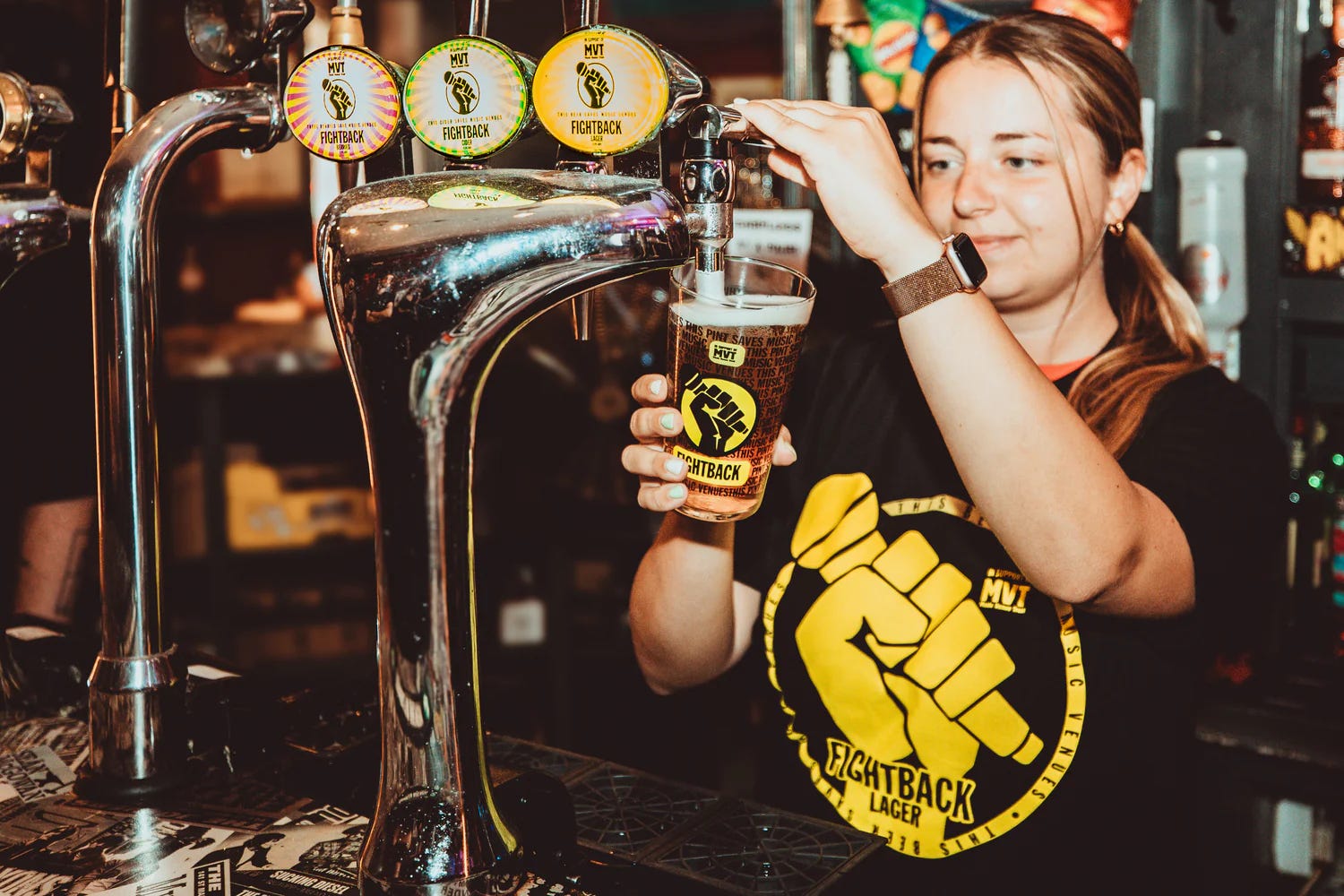
I know I am biased, but from where I view things there is an additional level of ‘healthy drinking’ above the pub, and that’s the grassroots music venue. My biased view of the pyramid of positive drinking is based on very practical experience. I have stood at the back of those rooms and watched strangers become a crowd and a crowd become a community in the space of three songs. In that environment alcohol is not the main event, it is accompaniment. The point is the music, the shared experience, the collective release, the sense that something is happening that could not happen on a sofa. In those rooms the drink you buy does not just lubricate conversation, it subsidises culture. Grassroots venues operate on margins so thin you’d struggle to push a plectrum into it; across the sector we are talking about profit levels that hover around statistical insignificance. Live music itself is almost always delivered at a loss, underwritten by bar spend. Put simply, the pint is the biggest funder of the pipeline.
Now layer the tax data over that reality and the picture quickly becomes stark. Even after the introduction of Draught Relief, duty on a typical 4.5% ABV pint sits at roughly 53 pence, meaning around £1 in every £3 spent in a venue goes directly to the Treasury before the venue has paid wages, rent, energy or artists’ fees. At the same time, alcohol sold in supermarkets for home consumption avoids the premises, licensing and environmental costs and operates with substantially lower staffing overheads. Worse still pricing structures for off sales, particularly in supermarkets, actively promote excessive consumption, including both using large quantities of alcohol as a loss-leader product and making high-strength products extraordinarily cheap per unit. Attempts to correct that through Draught Relief have run head-first into inflation-busting increases, effectively neutralising much of the intended relief for on-trade venues while leaving the structural imbalance between supervised and unsupervised drinking largely intact.
The wider modelling on pricing and health outcomes makes this more than a cultural argument; it is a public health one. Economic analysis has consistently shown that even a 10% reduction in overall alcohol consumption could prevent thousands of alcohol-related deaths and hundreds of thousands of hospital admissions annually. Scotland’s experience with minimum unit pricing, which drove down overall sales by around 3% and reduced alcohol-attributable deaths by more than 13%, demonstrates that price signals work, particularly at the cheapest, highest-strength end of the market. Yet minimum pricing alone allowed significant windfall margins to accrue to retailers rather than the Exchequer, underlining the point that if we are going to use price as a lever, we should design it properly and capture the public value it creates.
If government is serious about growth in music, about that much-vaunted creative industries engine, it needs to understand this basic fact: The economics of alcohol in licensed spaces are directly connected to whether the next generation of artists gets a stage. So why does the tax system behave as though a bottle of the cheapest high-strength alcohol consumed alone at home is equivalent to a pint bought in a venue that is employing staff, developing artists and holding a community together? It is not equivalent. Not in health outcomes, not in social impact and not in economic multiplier effect.
We have spent years working with DCMS to try to solve problems that do not start in DCMS, and that is one of the quiet failures of cultural policy. We hold consultations about music strategy while the real structural pressures are embedded in Treasury decisions, in health frameworks and in planning law. But the truth is that the biggest opportunity to create a transformative music policy of the next decade will not start in a culture white paper. It will start in a health reform, because this is fundamentally about harm reduction and behaviour, and the cultural dividend that follows is an unintended, but incredibly useful, outcome of that.
The opportunity is straightforward. Rebalance alcohol duty so that licensed, on-premise consumption in regulated environments carries a much lighter tax burden than the cheapest, high-strength off-trade alcohol that is disproportionately associated with harm. Do it in a way that is revenue neutral so the Treasury does not find itself staring into a fiscal hole. Shift the price signal enough so that the cheapest option is no longer the most isolating one. As a health policy alone, this is not radical, it is rational. We already use tax as a steering wheel; we tax tobacco heavily because it kills, we differentiate vehicle tax by emissions and we vary VAT to shape consumption. The idea that alcohol duty must be context blind is a fiction. Alcohol Duty is already shaping behaviour, just not necessarily in the direction we claim to value.
Right now we talk about a loneliness crisis while making the solitary drinking option cheaper. We talk about vibrant night-time economies while squeezing the very venues that make them possible. We talk about music as a national asset while allowing the economic model of its grassroots to sit permanently on a knife edge. There is something faintly absurd about holding meetings about community cohesion in venues that are funded by the bar takings we are simultaneously reducing with ill-considered taxation. The health case for rebalancing is clear enough: Harm clusters in particular patterns of consumption, especially cheap, high-strength products consumed in isolation, and modest price shifts at that end of the market can have outsized impact. The economic case is equally clear: Money spent in a pub or music venue circulates locally, paying wages, supporting suppliers and keeping high streets alive after 6pm, whereas money spent on loss-leading supermarket alcohol behaves differently, flowing upwards and outwards with a much weaker local multiplier.
Then there is the cultural dividend. At the top of this way of thinking about drinking hierarchy sits the grassroots music venue, the forge where British music is actually made, not in boardrooms or arena VIP lounges but in small rooms with sticky floors and faulty air conditioning and bands who have not yet realised they are about to change someone’s life. If we want more of that, we need to understand that alcohol policy is music policy, health policy is culture policy and Treasury policy is community policy. The next big policy win is sitting in the middle of this Venn diagram precisely because it aligns incentives across departments: Health sees harm reduction, Treasury maintains revenue stability, high streets regain footfall, music gets oxygen and communities get rooms full of people instead of rooms full of screens.
For a government that has publicly said that it wants to prove it can think across silos, this is the test. Stop pretending that the biggest change we could make to support grassroots music sits in the policy remit of DCMS; it does not. It starts where money moves and where health data lands. We can continue to subsidise the sofa, or we can tilt the system, gently but deliberately, towards the community chorus.
If we truly believe that connection is protective, that shared experience matters and that culture is not a luxury but infrastructure, then the tax system should reflect that hierarchy, because at the bottom sits isolation and at the top sits a packed room, a rising bassline and 300 people singing words that did not exist until someone was given a stage. That is the environment we should be nudging people towards, and the lever to do it is already there.
Totally agree. It’s interesting being in Thailand and seeing how marijuana can only be smoked in designated areas. It makes it a safe, social, regulated and de-stigmatised experience rather than a lonely sofa spiral. Really great arguments, always enjoy reading your posts!
I can see quite clearly why so little profit is being made in grassroots venues nowadays. I travelled up from London to attend the MVT/MVP party at The Croft in Bristol yesterday. 3 fantastic local artists playing to an appreciative audience. Of course, as the night went on the footfall increased and more alcohol was purchased. On this, I have to be honest and say that I had a few beers in the Wetherspoon’s beforehand but this post has galvanised me now to ensure I don’t do this from here on in. A small change for me but a principal led decision nonetheless to ensure that just that little bit more money goes to grassroots venues. Had the most amazing evening talking to Chris and Matt from MVT and also spoke to the local councillors afterwards, one of which gave a nice speech about supporting local grassroots venues. Mark, with each and every Substack post you put out I’m being truly well informed at a level of information I just cannot source elsewhere. Really enjoy reading your posts👍