
Good News Week
Success abounds, but it has never been so uneven. Hopefully there's more of a (Master)plan.

Every week I try to not just have a rant, satisfying and cathartic though that might be, but try to use any time you have available to spare reading these things by pointing out what is going on in the live music industry which could actually be making a difference. I know it can sometimes seem like all I do is moan about stuff, but you wouldn’t believe how much I’d like to stop doing that and instead tell you about all the positive things happening. So here’s your positive data facts for this week:
From Monday 7 July to Sunday 13 July inclusive 56 Arena and Stadium events took place in the UK. 1,253,620 tickets were on sale for those events, generating a potential gross of £139 million in ticket income. £14.2 million in ticketing fees, transaction charges, fulfillment fees and other service charges were added to those tickets. £4.3 million in maintenance, restoration and facility fees were then added on top of the ticket price and the service charges. That’s a total potential income of £157.5 million. One week. In case you’re wondering, that’s not a blip - last week saw even more gigs with even more tickets and even more income - topping £160 million of income in the previous 7 day period. This is going to carry on pretty much all summer at the same level of tickets and gross income, and this data, more than a million people a week enjoying live music at Arenas and Stadiums and generating huge revenues, doesn’t even include festivals.
The incredible success and vibrancy of the live music industry at the top end of the market is not a thing to be condemned or frowned upon, it is to be celebrated. There are fantastic, life-affirming shows being delivered across a vast range of genres by a huge range of artists. This end of the market has never been more successful, and it has never earned that success more - years of development has gone into this success. The sheer quality and scale of the events is a testament to the fantastic skills and knowledge we have in our live music industry in the UK. I don’t think it’s too much of stretch to say that we are enjoying a golden moment of live music which is emerging from sixty plus years of development and training to produce events that are genuinely the best they have ever been.
Those events don’t just create joy, life-changing and life-enhancing moments for audiences. They create tens of thousands of jobs, are a huge boost to local economies, and generate substantial tax income for the government. £26.25 million has been raised for government coffers just in VAT in just this one week just from these 57 shows. Which I guess raises the interesting question of whether the recent announcement of £30 million of public funding across the next 3 years to support grassroots music in the Creative Industries Sector Plan is really as much as it could or should be compared to the money being brought in from that same industry?
This level of success is a thing to be applauded and lauded in and of its own right, but the good news doesn’t have to end there. Its potential to support the whole live music ecosystem presents a massive opportunity.
The live music industry is committed to delivering £1 from each of those tickets sold so that we can get the grassroots sector back on its feet. That’s not me saying that, it’s the official position of LIVE, CPA, NAA and a host of other acronym friendly trade bodies who have collectively decided that it’s the right thing to do and they are going to do it. If you want a practical reason why they might be doing that, outside of the threat that national government might make them do it by law if they can’t do it by common sense, the average age of the headliner of the 57 Arena and Stadium shows this week was 53. So, you know, it’s not just Ozzy that might be retiring from live performances or Jeff Lynne that sadly found himself too unwell to perform. Everyone in the industry will need to address our demand for new artists to keep this success going.
There’s an additional element that is troubling for the UK as a music producing nation, and certainly for government, in that of the 56 events taking place this week only 28 of them feature British headliners. There’s no need to get on any nationalist bandwagon to recognise the simple fact that a British headliner is more valuable to the UK economy both in the short and long term, creating more jobs for UK crews and teams immediately and more revenue for HM Treasury in the long term, than a similar artist from the USA, Korea, India, Germany etc, all of which have seen headliners this week. No long-term data is held on this factor, but I think we can safely say that as a leading music nation we are, this year, probably at an all time low in terms of percentage of headliners, only 50%, at Arena and Stadium events. It’s a global economy. We need to ensure that our talent development structures are keeping up with it and keeping ahead of it. A lot of ink has been spent on the subject of Swiftonomics, but a country that produces a Taylor Swift benefits exponentially more in economic terms than a country that hosts a Taylor Swift.
It’s obviously a bit disappointing that in these seven days, from over 1.2 million tickets sold and £150 million in income generated, only £90,000 has been raised to support the grassroots sector, because only Ed Sheeran’s tickets in Ipswich contained the £1 contribution the live music industry is committed to delivering. But even this is progress; none of the Arena and Stadium shows last week had it included and the work put in by Ed (artists), Grumpy Management (manager), Kilimanjaro Live (promoter), Communion One (promoter) and One Fiinix (agent) demonstrates to the rest of the industry that it is very possible to collaborate and simply get this done. The expectation is that their example this weekend will spread and lead to the industry meeting the government target of at least 50% by the end of 2025. If that is the case then every single one of these events can be addressing the issue of where talent comes from and people’s access to music in their local community by the end of 2026, creating a fund of more than £20 million to address the issues faced by the grassroots sector.
Let’s park whether that bigger picture of adoption of the levy will or won’t happen for now (if you want to read an assessment of how well it’s going you can check out last week’s piece), because there is a very different, and potentially real, issue with all this good news. Before we move on and I annoy anyone, let’s say it one more time for the people at the back: I genuinely think all these brilliant shows are good news, but that doesn’t mean we can’t explore what impact they might be having elsewhere that is not quite so positive.
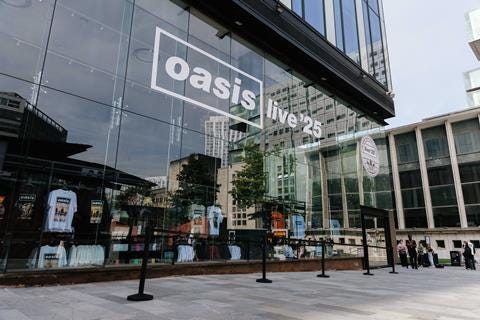
These fantastic events are generating serious concerns among a lot of grassroots music venues, promoters, artists, and that concern is now creeping into mid-level concert events and festivals.
While over a million people a week are going to see shows at Arenas and Stadiums, fewer people than ever are attending small-scale live music events. Average attendance per gig in GMVs is down 15.4% since 2023. The number of shows is down 12.5%. Total ticket sales for grassroots venues fell by 13.5% in value last year. It’s hard to ignore the possibility that the massive pull of big-name tours at the top end might be sucking the oxygen out of the room for everyone else, leaving less time, money, and attention for discovering something new and local on a Thursday night. The music economist Will Page expressed the opinion a couple of years ago that sales at Arenas and Stadiums were having no impact on sales further down the live music pyramid, seeking to blame other factors and putting forward the theory that no one attending Wembley Stadium was going to be attending the Lexington. Arena and Stadium gig-goers, postulated Will, were an entirely different species of music fan.
Being as generous as I can be for an opinion I disagreed with at the time, that rose-tinted view now seems substantially out of date. Ticket prices for the larger shows have exploded. The number of larger shows has exploded. The concept that all these events are filled with people who otherwise wouldn’t be attending any live music events at all is fatally flawed - and obviously so, given the origins story of the vast majority of the headliners.
We need to be really careful not to turn that into some sort of false opposition - the big gigs versus the small ones. That’s not what this is. But if we’re going to sell a million tickets a week to just 50 shows, then open up special boutique stores in city centres to flog those same people merch, while unfortunately, by the very nature of the events and the basic rules of capitalism, leaving a large majority of them with no choice but to pay through the nose for hotel rooms and transport, we have to ask; how does that shape people’s wider behaviours, habits, expectations and spend? Particularly given how those 50 shows dominate national press, trending topics, and even the algorithms that tell us what we’re supposed to be interested in. Because meanwhile, back at the local venue, the tour that should be stopping in your town just got cancelled. Again. Or maybe it never got booked in the first place.
So yes, celebrate the success at the top end - it’s incredible and deserves every accolade. And celebrate and applaud the work of the artists, managers, agents, promoters, ticketing companies, crew, production, sound and lighting technicians who make it all possible and are bringing the nation a summer of music greater than we have probably ever seen before. But we need to face the fact that if the whole ecosystem isn’t supported, those top end shows are going to run out of future headliners and this summer is not the new, glorious normal. It’s the tail end of the Golden Age of Live Music.
If we’re not careful, we’ll have created a perfect storm: all the attention, money, and glory going in at one end. Nothing coming out the other.
That’s not a pipeline. That’s a drain.
Its so dis-heartening that the big boys have forgotten their roots.
I was in Mcr yesterday for a drink with old friends, the place swarming with oasis beanie hats and t-shirts and I thought even if they gave us a percentage of their merch sales that at least would be something.
I can’t get my head around why most of them are choosing to ignore our plea.
I thought musicians were then best set of people to come together when someone needs help.
What do I say to the kids I’m working with who are forming bands and are looking to play gigs?
Anyway keep up the good work.
Thanks Mark, I always appreciate your in depth updates.