
Help!
If you're feeling washed out by the need to constantly help venues out, you're not the only one.

Amelia Vandergast has written an excellent piece for A&R Factory called The Guilt Trip: Why Punters Can’t Save Grassroots Venues While Institutional Giants Bleed Them Dry. It puts out in public something we discuss very often in MVT, something we can best term ‘compassion fatigue’. I strongly recommend you read it.
Amelia has described a specific pattern that anyone close to Grassroots Music Venues will recognise immediately: Venues in trouble, and too many of them are in trouble and we all know it, being forced to ask their audiences and their communities to save them, again and again, ticket by ticket, crowdfunder by crowdfunder, until asking feels like it is an inherent element of the business model rather than the last resort it should be. Her piece traces where money that music fans spend at their local venue is actually going once it leaves the fan’s pocket, and her article lands, correctly, on the point that some of it ends up in the wallets of people who could be doing something about it and are choosing not to.
She correctly names organisations like PRS for Music as one of the institutions responsible for the financial shortfall audiences are being asked to cover when the call for another campaign to save another venue goes out. In that specific case, she sets out Music Venue Trust’s Set The Record Straight findings in detail, hundreds of thousands of pounds in billing discrepancies uncovered across England, Scotland and Wales, venues charged against theoretical maximum capacity rather than anyone who actually walked through the door, five County Court Judgments landing on rooms already running on nothing. She places that against PRS’s own reported numbers, more than a billion pounds paid out to rightsholders in a single year, and asks who that system is really built to serve when the money collected from a two hundred capacity room in a rural town ends up, by PRS’s own stated method, in the bank accounts of whoever already has the largest share of the market. It’s a clear, well evidenced, depressingly accurate but well-written, account of a real situation.
Her conclusion, that consumer goodwill has reached its limit and the fight needs to move upward, off the fan and onto the institution, is one I don’t have a single disagreement with.
I feel like I should stop and mention something about the website it features on, and the writing featured on that website, before I go any further. Because there’s a small but sharp irony sitting underneath this article that I don’t think should go unremarked. A&R Factory is a small but important outlet doing exactly the kind of serious, specific cultural criticism that’s becoming harder to find, in a media landscape where genuine writing competes for attention against an ocean of AI-generated filler and advertising models built to extract a click rather than earn a reader. The irony in this piece is that A&R Factory doesn’t bear just a passing resemblance to the argument Vandergast is making about audiences and communities being compelled to hold up the things we value; it’s pretty much the same argument, wearing a different outfit. Good writing about music and good rooms for playing it in are both a kind of infrastructure that somebody, at some point, decided should survive on public devotion rather than sensible funding, and both are now leaning on exactly the audience her piece describes, tired, generous, and being asked, once again, to prove they still care.
I know that a Venn diagram of readers of these regular articles and the audiences and communities Amelia describes in her article is basically a circle. If you’re reading this, you’re probably already one of the people who buys the ticket, subscribes to the outlet, buys the shirt, invests in the recording, tops up the crowdfunder. And you do it, and keep doing it, even when you’ve told yourself you wouldn’t, or couldn’t, this month. Amelia’s article gives me the opportunity to let you in on a secret: We see you. We see what it’s costing you, and we worry about it constantly, more than most of what we say publicly would suggest. We are not blind to the fact that the guilt trip Vandergast describes is real, or that it’s exhausting, or that it shouldn’t be your job to keep fixing a machine you didn’t break. What I’m asking, and I recognise how this sounds coming from someone who runs a charity the relies on your enthusiasm and passion, is please don’t stop caring while we get the actual fixes built. Because the alternative to an exhausted public that keeps showing up is not a rested public that gets asked less. It’s another Bath Moles.
What people who don’t care about this never get to see, and to be honest what I think even a piece as careful as Vandergast’s can only really gesture at, is what it actually feels like on the phone with someone running one of these places when the numbers stop working. I can’t name names, for reasons that will be obvious to anyone who’s had to make or receive the call themselves, but if you run a grassroots music venue and you’re reading this, you know exactly which conversation I mean. Quite possibly because you’ve had it with me. Nobody wants to run a crowdfunder. Nobody wants to be in this position. Nobody wants to feel that in some way they have failed, that they are letting their community down.
The most common thing I find myself doing in that call when it comes isn’t talking about spreadsheets, restructuring, letting people go, taking on yet another second job to keep things going. It’s persuading someone that the people who’ve stood in their room for years will actually show up if asked, and that asking isn’t a confession of failure. It usually is the opposite; it’s evidence of exactly the sort of place worth saving.
You don’t need me to tell you this. You can watch the dance of that ask when you see it played out in front of you on social media. A venue apologising, genuinely apologising, for a Patreon tier that gets you early access to tickets, a laminated lanyard, and your name engraved on a brick. As if handing someone a premium customer package in exchange for keeping the lights on were an imposition rather than the most reasonable trade either party will make all month. I once watched someone spend forty minutes drafting a single social post asking for help, agonising over whether “we need support” sounded too desperate and “we’d love your support” sounded too breezy, as though there were a form of words that could make “we might not exist in three months” sound like anything other than what it is. There isn’t. There’s just the facts, which need to said out loud, and the beautiful, moving thing that happens next, which is that people turn up and save the venue that means as much to them as it does to the person currently in charge of it.
I asked a venue operator once if they had a secure tenancy. They replied that their name was on the lease, but the reality was that they were simply the person in charge of keeping it open for as long as they could until it was the next person’s turn. The transaction between a venue and its audience and its community directly refers to that relationship, with the consequence that a struggling venue asking for help is much, much more than a simple monetary transaction dressed up as virtuous act. Both sides feel a completely inappropriate level of guilt in that exchange; the operator for having to ask, the audience for not having asked first whether help was needed. Nobody in it is behaving with anything but the best intentions. They’re two parties who care about the same fragile thing and don’t quite know how to say so without it sounding either like a confession of failure or some sort of act of weird saviour complex.
Which brings me to why I can’t let this piece end on anything resembling a nice comfortable pat on the back for all of us for giving this much of a crap about the places we live and the culture that surrounds us, because sometimes all of that, the care, the asking, the showing up, isn’t enough, and I watched that happen in Bath in 2023.
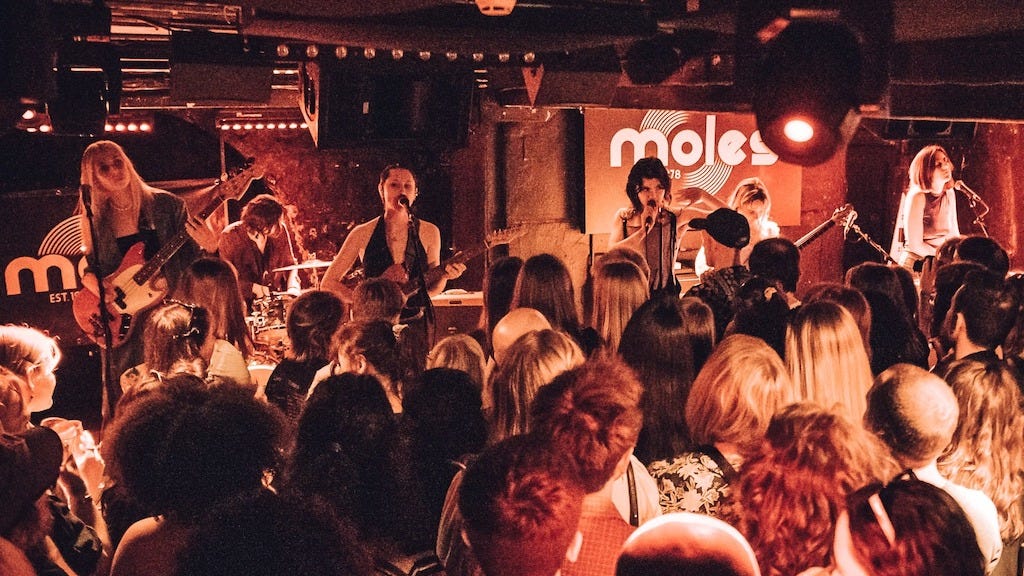
Moles opened in 1978 and closed, permanently, forty five years later, having survived a fire that gutted the inside of the building and a pandemic that shut it for the best part of two years, with a room of just two hundred and twenty capacity that had hosted more future arena headliners than I could list without the list becoming a whole piece in itself. Eurythmics and The Last Dinner Party in case you need two. Bath Moles didn’t close because the audience stopped caring. It closed because the team running it had already, over years, pushed every pound the bar and the club nights generated straight back into keeping live music going, had already done, from the inside, with their own margins, exactly what every crowdfunder like this asks an audience to do from the outside, until there was nothing left to push. A hundred and twenty four other grassroots venues had already gone that same year before Moles followed them. No campaign was going to be able to fix that, because the problem was never a shortfall that goodwill could cover. It was a perfectly valid business that as part of its core function must lose money on the thing it exists to do, at a rate no amount of love from the room, audience or community can outrun forever.
I remember what the day that Bath Moles closed felt like, and I suspect anyone in Bath who ever queued outside that door remembers it too; a specific, useless kind of grief and anger and frustration, the sort where you’d have pulled any lever going if one had existed, and none did, because the lever that was needed never belonged to us, or the operators, or the audience, or the community, in the first place. We’d been asking the industry for the tools we needed to prevent it since 2018. A simple request; £1 of every arena and stadium ticket, ring-fenced to support exactly this kind of room, so that exactly this type of room could go on producing exactly the sort of acts that sell our arenas and stadiums. And we didn’t pluck that idea out of thin air. France has run something close to it for decades, a compulsory 3.5% on ticket value that every British promoter, agent and artist touring there pays without apparent difficulty, because it’s simply understood as the cost of doing business in a country that decided grassroots venues were infrastructure rather than a nice-to-have. Here in the UK, we have been asking politely for that support for over half a decade. Moles closed anyway, and the devotion and passion that an entire city felt for it amounted, in the final account, to nothing at all that could change anything.
There’s a point I think both pieces, this one and Amelia’s, are both circling around, so let’s join them back together and nail them down. The solutions to all this are not theoretical. They are not waiting on research, or a working group, or some innovation nobody’s thought of yet. Billing PRS charges on actual attendance to hear actual music written by the actual songwriters you actually represent rather than a venue’s maximum theoretical capacity and never mind who wrote the songs is not a hard problem to solve; it’s literally a choice not to solve it. A levy with real teeth, set at a threshold that catches the promoters, ticketing companies, arenas and stadiums that can afford it (and if necessary enforced rather than requested nicely) exists in working form in another country a ninety minute ferry away. Agent of Change protections, business rates relief scaled to actual venue income rather than notional value, taking the VAT out of ticket sales, tax reliefs for venues that are just exactly the same as tax reliefs for theatres, tax relief for rock music that are the same as tax relief for classical music, none of this needs inventing. It needs delivering, by people who have had every version of these arguments in front of them for years and have chosen, repeatedly, to keep talking about it but not actually getting it done. That’s the reality that should make anyone angry. Not the fact that fans might eventually just run out of the capacity to keep caring and get tired of being asked, difficult as that is to think about, but the fact that the people with the power to stop anyone needing to ask them have had the answers on their desks since before Bath Moles closed and have simply declined to pick those answers up and just do it.
Andy Burnham takes office on the twentieth of this month, having spent nine years in a city that knows exactly what a Moles-shaped hole looks like once it’s actually there. He inherits a public that has already answered, unprompted, at real cost to itself, the only question a minister usually needs a focus group to ask, which is whether people care enough about this to back it with something more binding than an opinion. They already backed it. With the membership scheme, and the last-minute Patreon sign-up, and the ticket for a gig they couldn’t quite afford, and the crowdfunder donation, and, in the end, with a queue outside a venue in Bath that was closing anyway, because everyone in that queue for that final night already knew it wouldn’t be enough and they still came to try and see if they could stop it regardless.
In Bath, the MVT team, the venue operators, the audience and the community did their job. We, you, and they, have been doing it for years, all across the country, for hundreds of spaces that people care passionately about, badly compensated in any sort of gratitude from the industry and not at all in policy from the government.
The honest and uncomfortable truth sitting underneath Amelia’s piece, and this one, is that we’re still asking them, and by ‘them’ I mean you, to keep doing it, to keep showing up, to keep joining the scheme, and making the donation, and hosting the fun run, and sitting in a bath of beans, just to keep this whole sector afloat. And we have to ask them to keep on keeping on doing it until the people whose job this actually is finally show up like the cavalry at the last minute to stop it happening.
Joe Strummer said “Without people, you’re nothing” and he was right. So please could some of the people that could actually change this turn up and join in before the rest of us get too exhausted to carry on doing their jobs for them?
Once again you present the facts so clearly Mark. Collectively, we, as grassroots venues loving attendees, only have so much goodwill and patience to give until something has to shift. My comments on direct protest on previous posts have gone pretty much unnoticed. Should we not just start turning up at the offices of PRS and Live Nation with banners and the like? I’m all in on this but would need to see some genuine interest from others for me to begin a process of organised activity before I can commit. I’m 60, retired, I have a certain amount of free time and I’m genuinely angry about the neglect these unaccountable institutions show towards doing THE RIGHT THING!!!!