
Things Can Only Get Better
Somewhere between an empty bottle of Blue Curaçao and the eleventh Venues Day, something small but extraordinary has happened to grassroots live music.

The first Venues Day happened at the Queen Elizabeth Hall on the Southbank in December 2014, which, in retrospect, set the tone rather well. A sector that had been told repeatedly it didn’t matter, assembling in one of the most significant cultural buildings in the country to insist that it did. The formal part of the day went well enough. It was afterwards, when proceedings relocated to a boat on the Thames, that things descended into the kind of cheerful chaos that anyone who has spent time around grassroots music venues will recognise immediately as their natural habitat. The precise details are disputed, although the captain’s comment to me at the end of the short cruise is a matter of record. In all of his 35 years of running the boat, this was the first time he could remember declaring that every drink on board, including the Blue Curaçao, had been disposed of.
When Music Venue Trust invited the grassroots music venue sector to come together for the first time in 2014, the assumption was that we would gather a modest number of people who shared a modest ambition; to understand what was happening to their venues, and to try to do something about it. What nobody quite anticipated was the genuine appetite in that room for something much bigger and bolder. There was an overwhelming feeling that people had been waiting, without quite knowing it, for someone to call the meeting for a very long time.
More than a decade later, Venues Day 2026 took over Shoreditch Town Hall this week for its eleventh edition. This year’s theme was “This One Goes to Eleven.” It was, as these things usually are with MVT, both a joke and a statement of intent.
The early Venues Days were, by necessity, reactive. The sector was haemorrhaging venues at a rate that made forward planning feel faintly absurd. The conversation in those rooms was dominated by survival, by the particular exhaustion of people who had spent years fighting planning applications, negotiating with licensing authorities, and absorbing noise complaints from neighbours who had moved in next to a venue that had been there for thirty years and seemed to believe the problem was all those noisy drums they could hear. The gatherings gave the sector a place to voice that exhaustion, which mattered enormously. But voicing it and changing it are different things, and for several years the gap between those two activities felt very wide indeed. Too often too wide.
What the early Venues Days did, though, was something more structurally important than it appeared at the time: They built the network. People who ran venues in Manchester met people who ran venues in Bristol. Scotland met Wales. The micro-communities that had formed around individual cities discovered that they were part of something larger, and that the problems they had assumed were local were in fact systemic. That shift in understanding, from isolated crisis to shared understanding of structural failure, was the foundation everything else was eventually built on.
Agent of Change coming into national planning policy in 2017 was the first moment the sector properly understood what such a network could actually do. It had taken years of patient, unglamorous work - evidence gathering, parliamentary engagement, and sustained and persistent lobbying from a sector that had previously had no mechanism for speaking with a single voice. Venues Days played a primary role in how that voice was built. They are not a campaign tool, exactly, they are more like a no-holds-barred rehearsal space with a side order of free-form jazz. Venues Day became a place where arguments were tested, evidence was shared, and the sector’s collective understanding of its own situation was sharpened year by year.
When the pandemic arrived in 2020, the network proved its worth in ways nobody had anticipated. #SaveOurVenues raised £3.8 million in weeks and helped unlock more than £80 million in government support, because the relationships were already there, the data already gathered, the case for a sector in crisis already framed by years of struggle. The venues trusted MVT to make their case for them, because they knew MVT understood the sector with a depth and granularity that no government department, and almost no other part of the cultural sector, could match. Venues Day has been, among other things, a decade-long exercise in building that trust; in establishing that this is an organisation that shows up, that keeps its word, that understands the difference between advocacy and self-promotion.
The years between the pandemic and 2026 were, in many ways, the hardest. Venues that had survived the lockdowns faced a different and in some respects more insidious set of pressures; the rising cost of energy, of staffing, of debt taken on during the crisis itself. The sector had been saved from one emergency only to be delivered into another, and the mood at Venues Days in those years reflected that. There was resilience, but there was also a weariness underneath it, the creeping sense of fear that perhaps the fight was permanent, and that takes its toll on health, well-being, and mental resilience.
Its been my personal good fortune to stand at the front of that room for each of the eleven Venues Days. After all that time, you get to know what it feels like when people are holding on. You get sensitive to the particular quality of applause when a crowd is grateful but exhausted, when they are glad someone is fighting but have very serious doubts that the fight can actually be won. There have been many years where the energy was essentially defensive, a community drawing together because the walls were closing in, taking comfort from solidarity because there was not yet enough good news to take comfort from anything else. I have given speeches in that room where the honest, unmediated version of what I was saying was “we are all still here, and that has to be enough of a victory for now.” I think the audience at those events always understood that, which, to be honest, was sometimes the hardest part to take away from the gatherings.
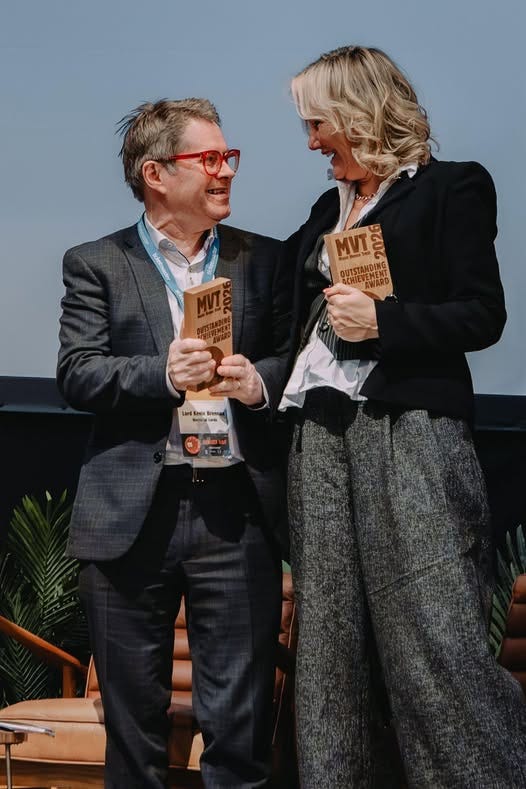
Venues Day 2026, however, felt different from the moment people arrived, and not just because the Outstanding Contribution Awards, which are a traditional part of the opening of the day, went to Lord Kevin Brennan and Dame Caroline Dineage, two parliamentarians from opposite sides of the House who have done more than almost anyone outside the sector to ensure grassroots music venues are taken seriously where policy is made. Recognising them together, in the same ceremony, in a room full of people who have spent years being told that parliament doesn’t really understand their world, landed differently to previous years’ opening sessions. It said, before a single workshop had begun, that something out there had genuinely shifted. The room received it not with the grateful relief of people surprised by good news but with a genuine ovation for the work and the possibility that it might finally mean real change was coming.
The room itself is worth describing, because Venues Day attracts a particular kind of person and always has. There are the seasoned, veteran operators; people who have been running the same two-hundred capacity room for twenty years and have the thousand-yard stare and the unshakeable opinions about monitor wedges to prove it, but who keep showing up because showing up is what they do. There are also the newer faces; younger venue managers discovering for the first time that the thing they thought was their problem is everybody’s problem, visibly relieved to find themselves in a room that doesn’t require qualifications or any explanations. There are lawyers, ticketing companies, equipment suppliers and the occasional bewildered journalist who came expecting a trade conference and found something considerably stranger and more interesting. There are the MVT Gurus; the network of specialist advisors who have given their expertise to the sector often for nothing, or close to it, and who carry about them the air of people who have heard every conceivable variation of a licensing problem and remain, against all reasonable expectation, willing to hear one more. It is not a typical conference crowd. It is a crowd of people who care way too much about something most of the world takes entirely for granted, and who have long since stopped apologising for that obsession.
What was different this year was not who was in the room but what they had brought with them. Because what has changed, in the years between the hardest Venues Days and this one, is that the sector has stopped simply absorbing punishment and started accumulating wins. Agent of Change is in the National Planning Policy Framework and has been long enough that developers are starting to simply accept it. The CMS Select Committee recommended a voluntary levy on arena and stadium ticket sales in 2024; the LIVE Trust formed in January 2025 to administer it. Business rates relief for grassroots music venues is now a political given rather than a campaigning aspiration. Music Venue Properties has taken seven venues into community ownership, with more than £4 million raised and over 2500 investors behind the Own Our Venues share offer; proof, if it were needed, that the public’s relationship to these spaces runs deep enough to put money behind it. The MVT Annual Report now tracks the economics of the sector with a precision that allows the argument to be made in front of Treasury officials in their own language, which is the only language Treasury officials reliably respond to. Rights management work that began as a quiet internal project is now producing evidence capable of holding the major collecting societies to account in ways the sector never previously had the data to attempt.
None of these things happened quickly. All of them were discussed and argued about at the Southbank in 2014, but it took more than a decade and eleven Venues Days, to get to a point beyond discussion and debate into something that looks a lot more like answers. The sector’s primary characteristic, it would be fair to say, is belligerent stubbornness. The difference in 2026 is that the results are visible, and visible results change the atmosphere in a room more reliably than any speech.
The content of the day reflected the shift. Previous Venues Days were structured, in large part, around the things being done to the sector; the planning decisions, the licensing pressures, the rent increases, the closures. Workshops were often exercises in damage limitation, helping venues navigate systems designed with no consideration of their existence. That work continues, and MVT does it every day. But Venues Day 2026 was noticeably different in its orientation. The sessions were less about surviving the present and more about designing the future, which sounds like a small distinction until you have sat through enough sessions that were definitively about the former.
The crisis communications session was a good example of how far the conversation has changed and matured. A few years ago, a session on how venues communicate under pressure would have been almost inevitably a session about desperation; how to launch a crowdfunder, how to frame a closure threat, how to make noise when the walls are closing in. What was delivered instead was a sophisticated framework for venues that understand themselves to be permanent institutions with long-term reputations to manage. It assumed venues that expect to be around long enough for crisis communication to be a recurring professional discipline rather than a one-off emergency. That is a different kind of session because it imagines a different kind of future.
The session on songwriters and royalties carried the same energy. The argument that venues have a role in ensuring that the correct songwriters are paid correctly for the use of their works risks sounding, on the surface, like another administrative burden being placed on already overstretched operators. But the data presented reframed it entirely. Across the whole of live music PRS processed 150,000 setlists last year. But GMVs hosted 174,552 events featuring an average of three sets of music each. Half a million sets in the grassroots sector alone, which would mean if every setlist PRS for Music received was exclusively for the GMV sector, which they aren’t, they would still only know what to do with 28% of the money These mathematics are not complicated, and neither is the conclusion; a sector that can demonstrate, with evidence, that PRS is structurally incapable of collecting enough data to pay its own members accurately is a sector that has moved from passive licensee to active participant in how rights are managed across the industry. The room understood the implications. It was, in its way, another small reminder that the sector is no longer simply subject to systems designed by other people. It is starting to actively interrogate them and demand systems that are fit-for-purpose.
That’s just two examples. There was twelve sessions exactly like this, getting into longstanding, complex issues with a depth that simply wasn’t possible in 2014. Each one, added together, created an entirely different type of day. One that was about how what the sector knows about itself can now shape a better future for the whole industry.
By the end of the day the room felt like a different room to the one that had assembled that morning. That wasn’t because anything dramatic had occurred, but because something cumulative had. I have been present at the end of all eleven of these days and I know how they usually feel. There is always warmth, always the satisfaction of a community that has spent a day recognising itself as a community. But the feeling at the end of 2026 was distinct in a way I did not quite have language for until I got some distance from it and sat down to write this out for you. The conversations after the event, when we all retired back to MVT Towers at the Strongroom, were wrong. Not wrong in content; wrong in register. They were not the decade-long conversations of people squaring themselves for another hard year. They were the conversations of people making plans, and to be exact, very specific plans, about very specific things, in the expectation that those plans would actually come to something. That is not how people talk when they are holding on, it is how people talk when they believe they are winning.
The sector that gathered in March 2026 is not the sector that argued its case on the Southbank in 2014, then continued the argument on a boat that probably should not have been trusted with that many people who feel strongly about the need to test the outer limits of the licensing laws. It is better organised, better informed, more structurally secure, and considerably more capable of arguing for itself in the rooms that matter. The problems have not gone away, let’s be honest, they will not go away, and anyone telling you otherwise is probably trying to sell you something. But the direction of travel has changed, and the people who run these venues, who have kept them alive through planning fights and noise complaints and a global pandemic and the slow grind of everything getting more expensive while the margins stayed thin, know it. They felt it on their way home and they are still writing to me about it several days later.
We are entering a new era for grassroots music venues. It won't all be perfect, and it won't all go smoothly for everyone. But it is, after eleven years of Venues Days, the right time to pause, to acknowledge it and to finally, hopefully, optimistically say that while it's not true that things can only get better, a sector is emerging that is at least confident that no matter how hard the road ahead may be, we collectively have a belief in the value of who we are and what we do that will carry us through it.
You will be pleased to learn that in 2014 the boat made it back. In 2026, so did we.
100% behind MVT’s stubborn belligerence! I think what you have shared is the hope that I felt from being there. Gotta have that when you’re trying to make the music industry work for you.
Reading that made me feel a little bit emotional.