
This is the Modern World
How a seemingly unimportant single sentence in a Government response to a petition tells you everything you need to know about why politics feels so estranged from the real life human experience

Earlier this year, a public petition crossed the threshold that forces the UK government to issue a formal response. Not a ministerial shrug, not a press release, but a written answer placed on the public record. The petition asked a surprisingly modest question: whether people should have a legal right to access essential services and participate in everyday life without being forced to use a smartphone or live digitally by default. Not to reject technology, not to retreat into the woods, just to not be excluded from society for declining to route every interaction through an app.
Twelve thousand people signed it, which meant the government had to respond. And it did, in the calm, inclusive language we have all come to recognise. The response talked about opportunity and accessibility, acknowledged that some people face barriers, praised the benefits of digital services, referenced action plans and collaboration. It read like something carefully designed to sound reassuring while making very sure nobody mistook it for a commitment to slow anything down.
And then, sitting there in the middle of it, came the line that matters:
Digital, the government explained, helps deliver cheaper groceries. Or, more accurately if you want to get into the subtext, the digital economy is exemplified by the concept of cheap groceries delivered to your door. Which is great, isn't it?
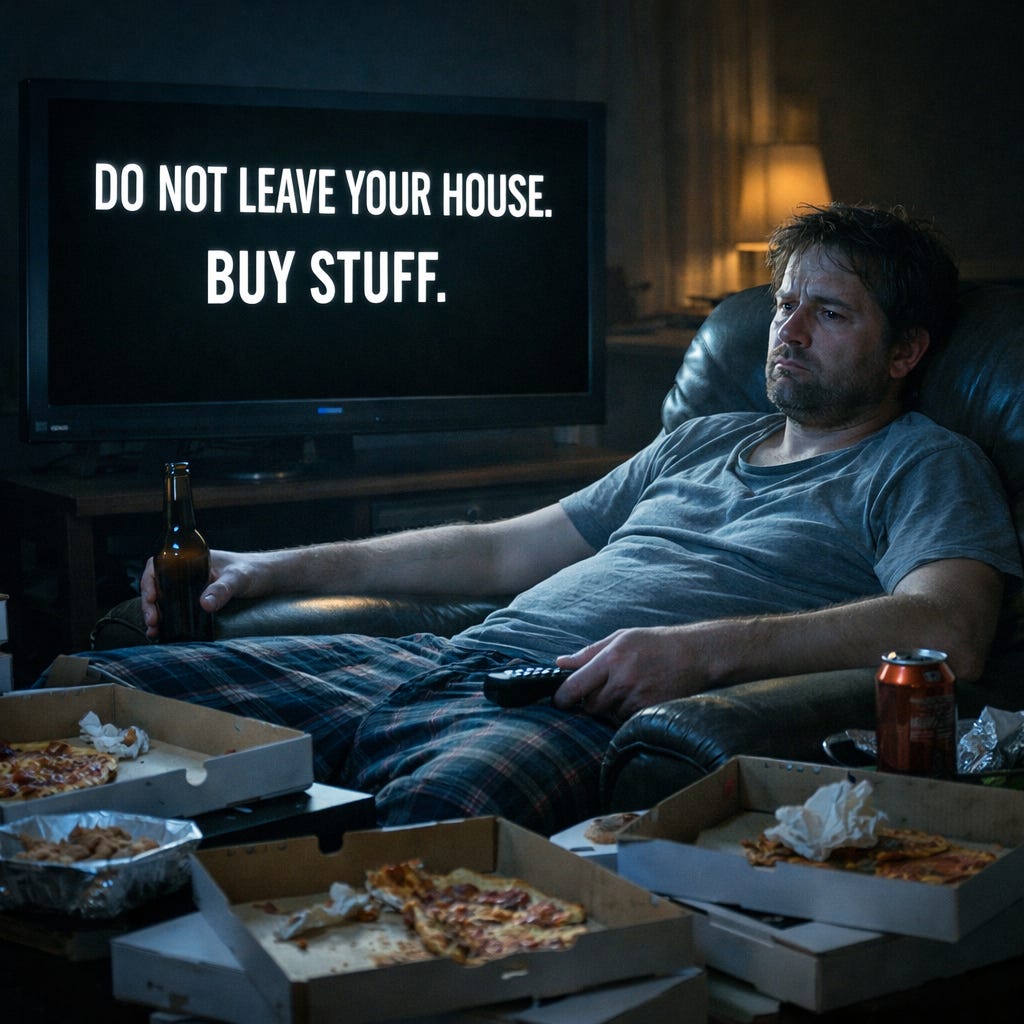
The trouble is that that sentence doesn't stop at being about groceries. It’s about a worldview. It’s the government saying, out loud, that frictionless, cheap convenience is a public good so important that it outweighs the social cost of exclusion, dependency and the steady erosion of physical alternatives. It outweighs the finite resources of the planet, meaningful jobs, sustainable work, social interaction, a sense of belonging, any concept of human value. It’s the reason the answer to the petition is ultimately no. There will be no legal right to a non-digital life beyond the narrowest definition of essential public services, because the direction of travel is not up for debate. Policy exists to manage the transition, not question it.
Once you stop treating that sentence as friendly colour and start treating it as policy, a lot of other decisions suddenly make sense. Cheap groceries delivered to your door do not appear by magic. They are engineered outcomes, produced by scale, logistics, automation, platform dominance and a tax and regulatory environment that makes sure those systems thrive while the physical world quietly carries the cost. This isn’t about whether online shopping is cheap and convenient. It obviously is. Full confession; I, too, have enjoyed the small luxury of not carrying bags of toilet rolls home in the rain to discover they have melted and I once ordered a curry when I didn’t much fancy human interaction. The issue is what happens when the desirability of cheap groceries delivered by a moped rider earning less than minimum wage becomes the benchmark for progress. Once that’s your metric, everything else becomes negotiable. Place becomes optional, community starts to become thought of as an eccentric sentimentality. Leaving the house starts to look inefficient. And, crucially, in case you think I’ve gone off on one a bit after just one sentence, the tax system is where this worldview has become operational.
Business Rates are the most obvious example. They tax physical presence, not economic power. They are payable before profit exists. They take no interest in margins, fragility or social value. If you occupy a building, you pay. If you don’t, you largely don’t. It’s a remarkably effective way of loading cost onto the parts of the economy that cannot move while quietly protecting the parts that can. That approach made a certain kind of sense when value lived where activity happened, when the shop was the marketplace and the room was the business. It makes far less sense in an economy dominated by platforms whose real value lives in networks, data, attention and scale. But it makes perfect sense if your political aim is to preserve the convenience of cheap groceries delivered to your door, even if that requires hollowing out the physical world in the process.
The local shop pays business rates based on an imagined rental value that bears no resemblance to its margins. The online platform pays minimal rates on a warehouse, and then works tirelessly to further minimise even that, claiming tax credits and tax relief for ‘creating jobs’. The marketplace itself, the thing that actually extracts the value, sits comfortably outside the property tax system altogether. This is not a design flaw. It is the system doing exactly what it was built to do. Every review of business rates that pushes down reliefs and pushes up rateable values but somehow manages to avoid meaningfully taxing digital value is reinforcing the same outcome. Physical businesses weaken, online dominance grows. Prices fall. Convenience increases. Job security gets ignored. Groceries get cheaper. Groceries get faster. Groceries get delivered to your door while the places people used to meet quietly disappear. Hooray, the system is working. Shame nobody has any work anymore and that everyone is lonely and we have a huge mental health crisis and a gathering storm of debt, alcohol addiction, and an endless future of human misery. But hooray… cheap groceries delivered to your door.
Nowhere does this logic look more absurd than in music.
An artist plays their first show at their first grassroots venue. That venue has already paid business rates on the building. It pays employer National Insurance on staff. It pays VAT on ticketing. It pays energy bills that feel actively hostile. It pays licensing fees, insurance, compliance costs. It takes the risk. It deals with noise complaints, transport cut-offs, licensing conditions and the simple fact that touring has been shrinking for decades. The artist is paid a fee and taxed on it. The staff are taxed on their wages. Every part of the physical chain is taxed early and repeatedly, very often pre-profit, long before anyone involved has made anything resembling a sustainable living. And everyone doing itis physically engaged in life, creating jobs for taxi drivers, and bus drivers, and the local petrol station, and the kebab shop owner.
Sitting above all of that annoying physical presence nonsense in music is the very efficient platform economy, the musical equivalent of cheap groceries delivered to your door. Spotify, because no matter what you read, they are the worst example, does not meaningfully invest in artist development, it reserves that investment for buying branding on football shirts and giving its founder money to invest in developing weapons to annihilate all those pesky humans. It does not pay for rehearsal rooms. It does not fund tours. It does not keep venues open. It does not underwrite the years of loss-making work that turns someone with an idea and a guitar into someone with a career. What it does do is extract value at global scale from music that was written, rehearsed, tested and proven in physical rooms, and then use international corporate structures to ensure that as little tax as possible is paid in any country.
So we end up with a system in which an artist playing their first show can trigger VAT, business rates, income tax and National Insurance before they have any realistic chance of sustainability, while the platform monetising millions of those artists contributes proportionately almost nothing to the society that produced them. If you were deliberately trying to discourage physical culture while rewarding extraction, you would struggle to design a better taxation model.
Grassroots music venues are such a brutal stress test for this worldview because they are unapologetically physical and unapologetically human. They do not scale. They do not optimise. Their value lies in people being in the same room at the same time, sharing something that cannot be automated, flattened or delivered next day. And you know that's true, because if the glorious, tax discouraged, data driven overlords of streaming could think of any way to make money out of it, every grassroots music venue in the world would be called 'The Spotify Live Music Experience'.
Grassroots Music Venues operate on margins so thin that calling them margins feels generous. Grassroots live music rarely makes money. It is subsidised through bar income. Culture is cross-subsidised through hospitality. Survival depends on a balancing act involving touring patterns, audience behaviour, staffing, licensing, transport and whether the boiler decides to give up at exactly the wrong moment. Honestly, sometimes I think boilers are sentient beings they are so good at choosing the wrong moment. Or maybe they are designed by one of Spotify’s mates.
Into this balancing act arrives a business rates bill calculated as if the venue were an investment asset rather than a piece of social infrastructure. A bill that must be paid regardless of whether profit ever materialises. When relief is reduced or revaluations land, the outcome is not mysterious. Venues close. Then we do the ritual; sad posts, angry memories, the “I saw my first band there,” the carefully worded regret that never quite stretches to doing anything differently next time.
But the musical groceries are cheap, and they are at your door, so the system is declared a success. And I have even mentioned that the musical groceries sound shit and by the way you are only renting them. That’s another column in itself.
What makes all of this especially frustrating is that the government already has simple, budget-neutral tools it could use to tilt behaviour back toward physical presence and social interaction if it wanted to. Alcohol Duty is the clearest example. If you genuinely wanted to promote healthier drinking, social connection and managed environments, you could increase duty on cheap supermarket alcohol designed for solitary, at-home consumption and reduce duty on alcohol sold in physical spaces where drinking is supervised, social and secondary to being with other people. You could make it cheaper to have a couple of drinks in a pub, a venue or a social space than to sit on a sofa with cut-price booze and a delivery app. You could discourage unhealthy, isolated drinking without banning anything, and encourage people to gather, talk, listen to music and exist together. Budget neutral. Massive mental and physical health benefits. Fewer people drinking themselves quietly into misery at home, more people out in the world with other humans. But that type of incredibly backward thinking would require recognising that physical presence is not a problem to be managed away, but a public good worth supporting.
And that, ultimately, is what that petition response reveals. Digital gets you cheap groceries delivered to your door. Therefore digital must be protected. Everything else must adapt, and if it cannot, it will be politely mourned and replaced. Grassroots music venues, like so often when you try to think of an example of poor policy, just make this logic visible sooner than most. They insist that value lives in the room. They keep opening the doors even as the system quietly asks them to disappear.
I am not a luddite. I like convenience. I like cheap groceries. I also like living in a society where people still leave their homes, see each other, discover new music, and build a life that isn’t mediated entirely by platforms that invest almost nothing in the human pipeline they profit from. If the government wants convenience to be the priority, it should at least be honest about what it is trading away to get it. And if it wants a healthy, connected, socially engaged society it has to stop taxing the physical, human layer into the ground while applauding the digital layer for making it easier to stay at home.
Cheap groceries delivered to your door is not a cultural policy. It is not a health strategy. And most importantly of all, it's an incredibly short term economic policy because once all the actual stores are closed, surprise, surprise, the digital system will no longer feel the need to be cheap. Anybody seen the latest digital streaming price rises?
Cheap groceries delivered to your door, then. How lovely. But you will forgive me if this particular luddite doesn’t actually believe they are worth the price of a silent room where there used to be a band.
Substack has many good writers, you included. It’s sometimes hard to press the like button as psychologically, it seems wrong to like a post which describes a shit subject, it’s the only tool we have to support, or not the content.
Being a musician all my life I totally agree with you and the great work of the MVT.
I am shocked that a Labour Government is sidelining the arts. Although I have heard venues are in a similar state, Eire supports its artists in a meaningful way ie giving them money to do what they do. Surprise, surprise there is a lot of music coming out of the country right now.
We currently live in Portugal where venues are thin on the ground, but the plethora of festivals supported by the Government and local authorities, provide well paid work for many Portuguese musicians.
On the general subject of this article I wrote a piece on the merits of releasing music digitally before dropping our last album. It may contribute to this discussion: https://vibes.starlite-campbell.com/p/to-stream-or-not-to-stream
Mark. Keep doing what you are doing and consider us 100% behind the MVT.
A depressing read, but spot on. And let’s also not forget how often the unknown, independent artists agree to play for bugger all. Because music venues and the community they create are so important. Thank you, Mark.