
Let's Dance
Get up outta of your rocking chair grandma. Time to save the future of humanity.

This week I want you to indulge me while we talk about dancing. Eventually, and with at least a little build up and a justification, I’ll talk about the birth rate. I promise it will make some sort of sense when I do.
A brief and incredibly incomplete list of some places I have danced: The Tropicana, Donuts, Chez Moi, Davinchis, WAG Club, Camden Falcon, Camden Barfly, Astoria 2, Smashing, Blow Up, on top of the World Trade Centre, in a former brothel, on stage in front of fifty thousand people, on stage in front of five people, in a remedial hydrotherapy pool where they taught me to walk again, and in roughly a quarter of this country’s finest remaining Grassroots Music Venues and probably another 25% of the one’s we have lost. And just so you know, I fully intend to do it in the other three quarters of them as well, probably with an added, and largely unrequested, crowd surf.
Some of those venues no longer exist. Several of the people I danced with in them are also no longer with us, which is the kind of sentence you only notice yourself writing when you have reached a certain age. The point I am making about this is not nostalgia. The point is that across roughly forty-five years of turning up in rooms where there was music and moving around in them, nobody ever filmed me doing it, and this, I have come to understand, was a privilege of a kind I did not know the value of at the time. I suspect none of us did, but dancing without the risk of a permanent record of your potentially embarrassing steps, swings, arm twirls and manic grins is now a distant relic of a bygone era. And that’s a huge problem.
I have spent the better part of twelve years in grassroots music venues in my current professional capacity, which means I have also spent a considerable portion of my recent adult life watching people stand completely still while a band plays at them. This has always happened to some degree. There is a long, and not entirely dishonourable, tradition of the person at the back with their arms folded who has come to listen, not perform, and fair enough. I mean you Steve Lamacq. What is new, and what I have watched spread across the last ten or twenty years like a very slow and extremely strange, and frankly dangerous, pandemic, is the curse of the raised phone. The person who has apparently paid money to be present at an experience and has instead chosen to be present at it only from behind a screen. And surrounding them, increasingly, the people who might have danced but have clocked the raised phones and decided, quite rationally, that they would rather not be on the internet doing something embarrassing. And those people are especially located in the 16 to 30 age group, the young people most sensitive to the judgement of what this will look like on the internet.
This is not, however, a column about what was better in the old days. It is a column about a specific mechanism by which a specific technology has broken a specific thing that human beings have been doing together since before we had written language, and the consequences of that breakage, which are considerably more serious than a dull festival crowd boringly filming a video they will never watch again of the only song they know by a band that have had a viral TikTok hit by accident and are now forced to perform it for hordes of disinterested social media ‘influencers’.
Let’s start, as Jennifer Aniston once said, with the science. Because the science on this is remarkable and almost never gets connected to the particular argument I am asking you to consider here.
Robin Dunbar, Professor of Evolutionary Psychology at Oxford, has spent three decades building an evidence base for what he calls the social bonding function of music and dance. The argument, briefly, is this; as human groups grew too large to bond through the physical grooming that works perfectly well for chimpanzees and baboons, they needed mechanisms that could produce the same neurochemical effect at scale. The endorphins released when bodies move together in synchrony are the same neurochemical system that fires when an infant is held by its mother, the same system activated by the trust-establishing behaviours that social primates use to maintain group cohesion. When Dunbar’s team ran the experiments, synchronised movement with other people produced measurable endorphin release in participants; watching other people move did not. This is not a small distinction. The bonding mechanism is in the doing. It has, to be clear, always been in the doing, and no matter which latest version of the iPhone you buy with whatever camera quality on it, filming the dancing is not the same at all as actually doing the dancing.
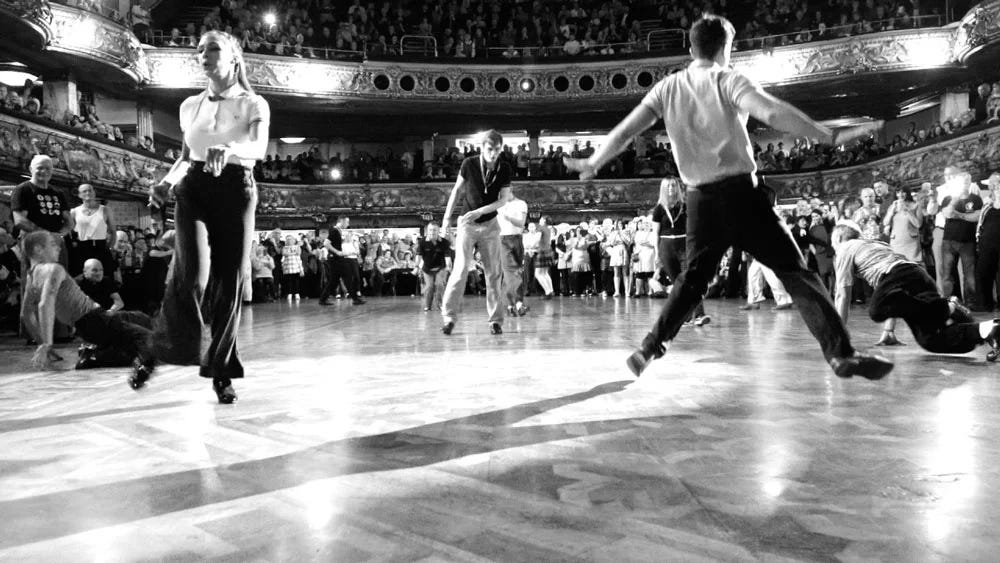
This helps explain something that is otherwise rather puzzling, which is that every human culture on earth, without exception, independently developed communal music and movement. Not most. Not the majority. Every single one. Anthropologists have found communities in extraordinarily different climates, at wildly different stages of social organisation, with no contact with each other whatsoever, all of which had songs and dances performed together, and all of which used those songs and dances at the moments of highest social stress; births, deaths, harvests, conflicts, the edges of the community’s shared life where the bonds between people needed to be renewed and confirmed. They didn’t dance because life was pleasant, they danced because the alternative was social dissolution.
This is the forty-thousand-year context in which to place the following observation: We have created the first generation in human history that is afraid to dance in public, and we have done it entirely by accident, and, really importantly, we appear not to have noticed what might happen if we do that.
The mechanism for how this has happened is not, for once, complicated. Short-form video platforms, and particularly TikTok and Instagram, have done something new to the experience of being in a room with music; they have made moving your body in public a permanent audition, a critic-worthy act inviting comment and judgement. It was always possible, in theory, that someone at a gig might be filming you. The difference now is that the phone is already out, the app is already open, and the algorithm that decides which forty million people will see the resulting clip is entirely beyond your control. The rational response to this is to stand still, and an enormous number of people are making that rational response. What nobody is fully accounting for is that the rational individual response adds up, collectively, to an irrational, civilisation threatening, outcome.
Watching someone dance on TikTok does none of the things that dancing is for. Not some of them; none of them at all. The endorphin release that Dunbar’s research documents requires your body moving in synchrony with other bodies. The oxytocin that strengthens social bonds requires actual proximity. The restoration of what depression researchers at the University of Hertfordshire identified as “agency,” the sense of being in your body and choosing what it does, which depression specifically removes, requires you to be dancing rather than watching someone else dancing. A screen, however large, however high-definition, however many followers the person on it has, produces zero of these effects. The platforms that have done the most damage to the dancefloor have also built a business model on the proposition that consuming dance content is an adequate substitute for dancing. It is not even semi-adjacent to adequate, it is the polar opposite of it and the consequences of that are not abstract, they are immediate and we are are slap bang in the middle of experiencing those consequences in real time.
A meta-analysis published in The BMJ, drawing on 218 clinical trials involving more than fourteen thousand participants, found that dancing with other people was more effective at reducing depression than walking, yoga, strength training, or several standard pharmacological treatments. Not slightly more effective, more effective, full stop. A 2024 narrative review in Mental Health Science found guided dance interventions associated with statistically significant improvements in depressive symptoms, alongside measurable decreases in loneliness and increases in perceived social support. Research from Kawase and Eguchi into community festival participation found that festivals where group dancing occurred produced stronger social bonds among attendees than festivals where it didn’t, regardless of whether participants had previously known each other, and regardless of whether they had wanted to attend in the first place. The dancing did the work even when the dancers were reluctant.
I danced in a remedial pool because I was hospitalised for months on end as a child and needed to rebuild the muscle memory of walking before I could do it on dry land. I mention this not for sympathy, which would be a terrible waste of your time, I am fine thank you, but because looking back at this with the fresh perspective that age provides you, even without the wisdom it was apparently supposed to bring, it seems to me that the reason it worked was not the pool or the carefully choreographed movements. It was the music they played in the room, and the other people in the water, and the movement that all of that produced.
The government’s own Community Life Survey, published in December 2025, records that the loneliest age group in England is not elderly people living alone in rural areas, which is the thing everyone pictures when you say “loneliness crisis”; it is 16 to 34-year-olds. Nine percent of adults in this age group report feeling lonely often or always. The generation that grew up with smartphones is the most socially isolated generation in the data, by the metric the government uses. The government’s response to this, as far as I can tell, has been to commission further reports on the loneliness crisis while continuing to allow the spaces where the loneliness crisis might be most directly addressed to close at roughly one every three days. There are some words for this type of government navel gazing while the building burns down around them, but I am going to be restrained and not use them.
I said I would mention the birth rate, so here comes that bit now. Brace yourselves: The total fertility rate in England and Wales fell to 1.41 children per woman in 2024, the lowest on record. The parliamentary research service is careful to note that declining fertility is related to a range of economic and social factors, which is true, but it is also true that dancing is, and has been for the entirety of human history, how people met each other, assessed each other, communicated physical availability and social confidence and the kind of rhythmic compatibility that, in the bluntest evolutionary terms, is some of what you are looking for in the person you are going to have children with. The dance floor was the original proximity technology, and it worked because it required you to be physically present in a shared space, reading real signals from a real body in real time, with no algorithm between you and the information. I am not so daft as to be making a causal claim. I am simply noting that both data points reflect the same underlying shift in how young people relate to their own bodies in shared public space, and leaving it there, because people who read these columns are perfectly capable of joining two dots together without me insisting they do so.
There are people who have begun to notice that something has gone wrong and a small number of them have done something practical about it. Ghost, the Swedish rock band who wear face paint and papal robes and are not, despite appearances, a novelty act, made their entire 2025 world tour phone-free using Yondr magnetic pouches that sealed attendees’ phones on entry. Their frontman Tobias Forge said it was the first time in more than a decade that he had seen a fully engaged crowd. Fred Again, the London producer who has become one of the most compelling live acts in the country, placed stickers over camera lenses at his Alexandra Palace residency earlier this year and handed out disposable analogue cameras instead, on the logic that the urge to capture the evening would not disappear and needed somewhere to go. Harry Styles did something similar at his Manchester show, distributing cameras with a card that read “dance with all your friends”. Eventbrite’s data shows that events marketed as phone-free grew by 567 percent globally between 2024 and 2025. Dear Apple, Google, Tik Tok, Meta: Listen up, the market is telling you something. What it is telling you is that people go to live music to be present, and that the phone is the thing preventing them from being present, and that when you remove it, something improves immediately that is very difficult to describe and very, very easy to feel.
The limitation of all of this is significant, so let’s acknowledge it plainly. Yondr systems require staff and infrastructure. They work at arena scale, where the artist has enough leverage to ask twelve thousand people to give something up. They have not filtered down to the 200-capacity venue in Sheffield or Coventry or Swansea where the culture of the dancefloor has always been formed, and where it needs to be recovered if it is going to mean anything for the people who most need it. Jonathan Haidt, whose work on the anxious generation documents in considerable detail the relationship between smartphone adoption and the collapse of young people’s willingness to take social risks, doesn’t offer a specific prescription for where to start reversing it, so I will: Start in small rooms, with loud music, where the stakes of looking stupid are the lowest they are ever going to be and the rewards of not caring are immediate and physical and well-documented in peer-reviewed literature going back thirty years.
I have spent twelve years arguing that grassroots music venues are social infrastructure. I have argued it in terms of the talent pipeline, the economic contribution, the cultural value, the community function. All of those arguments are true and I stand by all of them. But the one I have made least, and perhaps should have made more, is this one: Grassroots Music Venues are the places where human beings do the thing that human beings evolved to do together, the thing that is more effective than antidepressants at scale, the thing that binds communities together, reduces loneliness, releases endorphins, releases oxytocin, and apparently, if you do it enough and with sufficient confidence in a room with other people, results in the survival of the human species.
Put your phone in your pocket and dance.
I’m going to throw in another perspective as a ‘content producer’ (my pothole posts are things of legend on FaceBook)…and also as an erstwhile booker/promoter. In those latter roles I recently got asked by the mum of a talented young musician for tips on getting gigs.. one of my stock answers here is ‘live footage of the band performing to a responsive crowd’. In the former role I’ve been paid to go to festivals specifically to shoot ‘fan style content’ on mobiles from within the crowd (not stuff that looks professionally done) so that the event has ‘genuine’ content for their social channels. Some of these clips have gone million+ viral. But I’ve never had one complaint from anyone captured in these… and in all the years I’ve been dodging through circle pits and whizzing up and down the front barrier I can count on the fingers of one hand the number of people who’ve asked me not to use a shot of them. And I’ve immediately deleted the clip. Now we get into the grey area. I am (I think/hope) a responsible documenter of live events. I’m not trying to get laughs from a cruel audience by filming awkward moments. I’m trying to capture the joy and the energy that can only be found in the middle of a single-minded crowd who are brought together by songs. But where does this morph into the dark waters described in the post? I know there are definitely some people for whom this is an issue… but when you go to a big gig or festival with stage cameras panning across the audience is there anything fundamentally different between that and the person next to you with a phone? Even small venues these days often have fixed cameras filming all of the action so the band can have it as a takeaway benefit for future marketing. So in summary I don’t think this is a simple yes/no debate. It’s a bigger discussion of intent, consent, ethics, responsibility, empathy, and good old common sense. Some guidelines… but maybe not so far as strict controls, as that could have unintended consequences that would stifle event, venue, and band marketing opportunities in a world now dominated by the flip of the algorithm switch. In simple terms… if you don’t want to be filmed you need to be empowered by societal norms to “just say no”, and if you are the filmer and refuse to stop then maybe some form of punitive action might be warranted… what that might be I’m not sure. But it’s a bit like ‘no public drinking’ laws. In reality these don’t generally make it a crime to consume alcohol in public, but if you are asked to stop and refuse then that refusal is the offence. As a PS… if we want MORE dancing we need more MIRRORBALLS… officially listed by the Australian government as things that ‘may lead to dancing’ (and therefore to be removed).
The same may apply for those making music as well, who’re influenced to create their own, or share these ‘fan videos’ by their ‘team’ in order to show worth or value of their work. This can stifle the creative process - get in the way - in the same way that the lack of audience movement/dance might get in the way of the ‘pro-creative’ process.
This shit won’t go away, but having an alternative is hugely important, and the sooner people realise it’s cool(er) to be ‘in’ the moment than trying to capture it, the better.